How Much House Can I Afford?
Three simple rules, one worked example, and the number that actually matters — your monthly payment.

Do the math yourself — free, no signup:
"How much house can I afford?" is the first question almost every buyer asks — and most calculators answer it with a blank form. Before you type in a single number, here is how the answer actually works.
The short answer: three rules of thumb
No single rule fits everyone, but three of them together get you close:
- The 3x rule. A home price around three times your gross annual income is a reasonable starting point. On a $90,000 salary, that is roughly a $270,000 home.
- The 28% rule. Your total housing payment — mortgage, property tax, and insurance — should stay under about 28% of your gross monthly income. On $90,000 a year, that is $7,500 a month gross, so about $2,100 a month for housing.
- The 36% rule. All of your debt payments combined — housing plus car loans, student loans, credit cards — should stay under about 36% of gross monthly income.
These are starting points, not approvals. A lender looks at your credit, your debts, and your down payment too. But if a home breaks all three rules at once, it is almost certainly too much house.
The number that actually matters: the monthly payment
House prices get the attention, but the monthly payment is what you live with. And the payment is far more sensitive to the interest rate than most people expect.
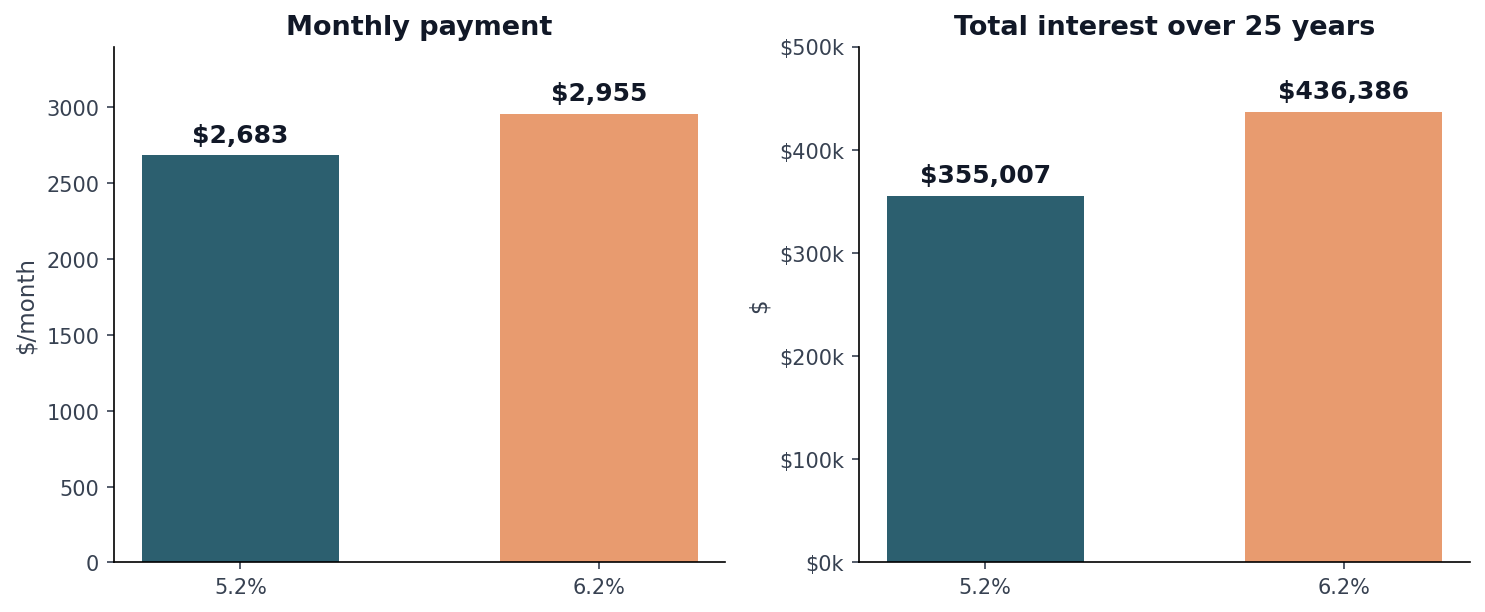
Take a $450,000 mortgage over 25 years:
- At 5.2%, the payment is $2,683 a month.
- At 6.2% — just one point higher — the payment is $2,955 a month.
That is $271 more every month, and $81,379 more interest over the life of the loan. Same house, same price, very different cost. This is why "can I afford this house?" is really two questions: can I afford the price, and can I afford the rate?
Here is the same $450,000 loan run through the mortgage calculator:
| At 5.2% | At 6.2% | |
|---|---|---|
| Monthly payment | $2,683.36 | $2,954.62 |
| Total paid over 25 years | $805,007 | $886,386 |
| Total interest | $355,007 | $436,386 |
ZenCalcs AI Insight: For this loan, you'll start paying more toward principal than interest after year 13. By the final year, you'll have built 100% equity — the house is fully yours.
That crossover year is the point where your payments start working for you instead of the lender — and the earlier it comes, the cheaper the loan is overall.
Try it yourself with the mortgage calculator: enter the price, then move the rate up and down by a point and watch the payment. If a one-point rise breaks your budget, the house is too expensive at today's rates — or you need a bigger down payment.
Don't forget the rest of the cost
The mortgage payment is the biggest line, but it is not the only one:
- Down payment. The bigger it is, the smaller the loan — and the smaller the payment. A 20% down payment on a $450,000 home is $90,000, and it also avoids mortgage insurance in many cases.
- Property tax and insurance. These ride along with the payment every month. They vary a lot by city, so look them up for the actual neighbourhood, not the national average.
- Maintenance. A common rule is about 1% of the home's value per year. On a $450,000 home, that is roughly $4,500 a year, or $375 a month, set aside for the roof, the furnace, and everything else.
- Closing costs. Legal fees, inspection, land transfer tax — budget a few percent of the price on top of the down payment.
Add those to the mortgage payment before you decide. A home that "fits" on the mortgage alone can still strain a budget once the rest is counted.
Your number in four steps
- Take your gross monthly income. Multiply by 0.28. That is your rough maximum housing payment.
- Subtract property tax and insurance for the area you are looking in. What is left is your maximum mortgage payment.
- Put that payment, your down payment, and today's rate into the mortgage calculator and see what home price it supports.
- Stress-test it: raise the rate by one point. If the payment still fits, you have room. If it doesn't, you know your real limit.
Or skip the arithmetic and ask the AI assistant in plain English — "How much house can I afford on $90,000 a year?" — and it will walk you through the same steps and point you to the right calculator.
This is general education, not financial advice. Lending rules, rates, and tax treatment vary by country and lender — treat these rules as starting points and confirm the details with a licensed professional before you buy.
More guides
- Black Friday Math: Is That '40% Off' Deal Actually a Deal? — November 28, 2026
- When Is My Baby Due? How Due Dates Actually Work — November 18, 2026
- What Pace Do You Need for Your Goal Race? — November 18, 2026