When Is My Baby Due? How Due Dates Actually Work
Your due date is counted from a day you weren't pregnant yet. Here's the 280-day rule, what moves the date, and what your week and trimester really mean.

Do the math yourself — free, no signup:
A positive test brings a hundred questions, and the first one is almost always the same: when is the baby due? The answer comes from a simple rule — and one detail that confuses almost everyone.
The 280-day rule
A due date is calculated from the first day of your last menstrual period (LMP), not from conception. The rule, known as Naegele's rule, is:
Due date = first day of LMP + 280 days (40 weeks)
Why count from a day you weren't pregnant yet? Because the LMP is a date most people know, while the exact day of conception usually isn't. Pregnancy is dated from the LMP by convention, which means "week 1" of pregnancy is actually the week of your period, and conception typically happens around week 2 — about 14 days after the LMP, for a 28-day cycle.
If your cycle is longer or shorter than 28 days, that matters: conception is roughly the cycle length minus 14 days after the LMP. The pregnancy calculator lets you enter your cycle length and adjusts for it; the due date calculator uses the standard 28-day assumption.
A worked example, straight from the calculators
Take a last period starting June 8, 2026. Here is what the calculators return:
| Last menstrual period | June 8, 2026 |
| Estimated conception | June 22, 2026 |
| Due date | March 15, 2027 |
| As of November 18, 2026 | 23 weeks, 2 days pregnant |
| Trimester | Second trimester |
| Progress | 58% of the way there (117 days to go) |
ZenCalcs AI Insight: You're currently 23 weeks and 2 days pregnant, in your second trimester. Your baby is due on March 15, 2027, which is 117 days from now.
Try it with your own dates in the due date calculator — enter the first day of your last period and it gives you the due date, the conception estimate, your current week and day, and your trimester in one go.
The trimesters, at a glance
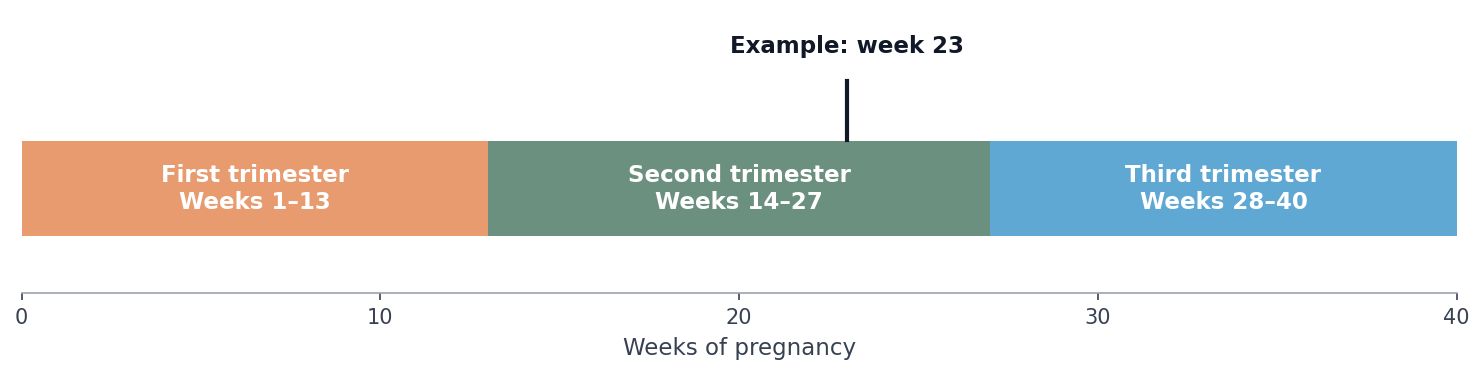
Pregnancy is divided into three trimesters, and the calculators use the same cutoffs to tell you where you are:
- First trimester, weeks 1–13. The early weeks: conception, implantation, and the formation of the baby's major organs.
- Second trimester, weeks 14–27. Often called the "easier" trimester — and the one most people are in when the pregnancy starts to feel real.
- Third trimester, weeks 28–40. The final stretch: rapid growth, and getting ready for birth.
Your week number is just how many full weeks have passed since the LMP. "23 weeks, 2 days" means 23 full weeks plus 2 days into week 24.
Why the date moves
A due date is an estimate, not an appointment. Only a small share of babies arrive on the exact day — most arrive within the two weeks before or after it. A few things can shift the date:
- Cycle length. A 35-day cycle pushes conception (and the due date) later than the 28-day rule assumes.
- Ultrasound dating. An early ultrasound measures the baby directly and is often more accurate than the LMP date, especially if cycles are irregular. If your clinician gives you a different date after a scan, use theirs.
- Irregular periods or recent birth control. Both make the LMP date less reliable as a starting point.
If the calculator's date and your clinician's date disagree, trust your clinician — they have the full picture, including the scan.
Your dates in three steps
- Note the first day of your last period (and your usual cycle length, if you know it).
- Enter them in the pregnancy calculator for the full picture — due date, current week, trimester, and progress — or the due date calculator for the quick answer.
- Bring the result to your next appointment and confirm it with your clinician.
Or ask the AI assistant in plain English — "My last period was June 8, when am I due?" — and it will walk you through the same steps.
This is general education, not medical advice. Every pregnancy is different — confirm your dates and any health questions with your healthcare provider.
More guides
- Black Friday Math: Is That '40% Off' Deal Actually a Deal? — November 28, 2026
- What Pace Do You Need for Your Goal Race? — November 18, 2026
- The $100-a-Month Habit: What Compound Interest Actually Does — November 18, 2026