What Pace Do You Need for Your Goal Race?
A 30-minute 5K means 6:00 per kilometre. Pick your goal time first, and the pace follows — here's the simple math, and what to do with it.

Do the math yourself — free, no signup:
Every runner has a goal time in mind — 30 minutes for a 5K, an hour for a 10K, a sub-two-hour half. But a goal time is just a wish until you know the pace it demands. The math is simple: pace = time ÷ distance. Pick the time, pick the distance, and the pace follows.
The headline example: a 30-minute 5K
The most common first goal in running is a 30-minute 5K. Here's what it takes:
| Goal | Required pace | Speed |
|---|---|---|
| 5K in 30 minutes | 6:00/km (9:39/mile) | 10.0 km/h |
| 5K in 25 minutes | 5:00/km (8:03/mile) | 12.0 km/h |
| 10K in 60 minutes | 6:00/km (9:39/mile) | 10.0 km/h |
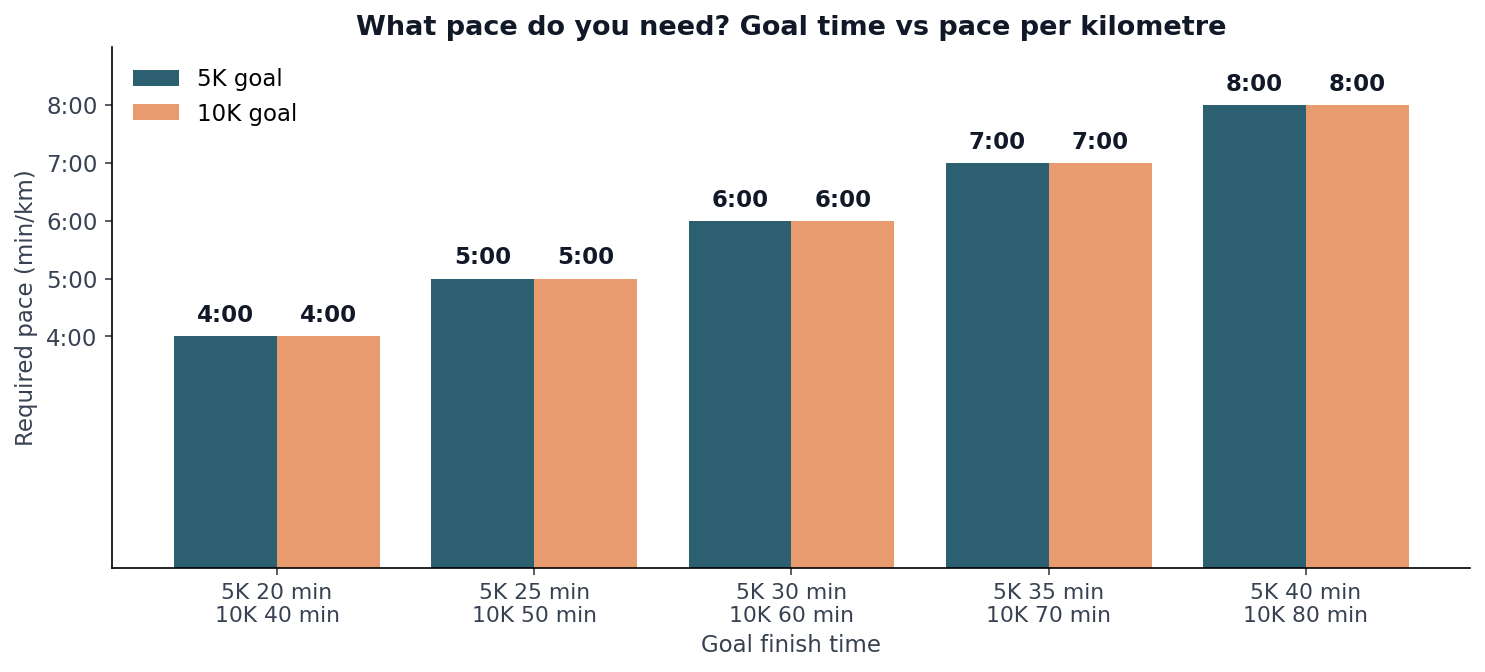
Notice the symmetry: a 10K in 60 minutes demands exactly the same pace as a 5K in 30 minutes — 6:00 per kilometre. Double the distance, double the time, same pace. That is why the 30-minute 5K is such a useful benchmark: hold 6:00/km and an hour-long 10K is the same effort, stretched out.
What the calculator says about a 6:00/km pace: "Your pace of 6:00 per km shows solid performance. Keep training consistently to improve."
How to read your pace
Pace is usually written as minutes per kilometre (or per mile). A few things that trip people up:
- Pace is the inverse of speed. Faster running means a smaller pace number. 5:00/km is faster than 6:00/km — one minute faster per kilometre.
- Per kilometre vs per mile. If your watch shows miles, 6:00/km is 9:39/mile. The pace calculator shows both, so you can train in whichever unit your watch uses.
- Even splits are the goal. The paces above assume you run every kilometre at the same speed. In practice, most runners start too fast and fade — so the required pace is really the average you need to hold, not the pace of your first kilometre.
Turning a goal pace into a plan
Knowing the number is the easy part. Holding it for the whole race is the training:
- Find your current pace. Run 5K at a comfortable hard effort and check the number. If you're at 6:30/km and your goal is 6:00/km, you know the gap is 30 seconds per kilometre.
- Train at the goal pace in pieces. Run intervals at 6:00/km — say, 5 × 1 km at goal pace with a slow jog between — so your legs learn what it feels like.
- Do most of your running slower. The bulk of training should be easy running, well slower than goal pace. The intervals teach the pace; the easy miles build the engine that sustains it.
- Test it. A few weeks out, run a 5K time trial and see how close you are. Adjust the goal if the gap hasn't closed — a realistic goal you hit beats an ambitious one you miss.
Find your number
- Pick your race and your goal time.
- Enter them in the pace calculator — it gives you the required pace per kilometre and per mile, plus your average speed.
- Compare it with your current pace from a recent run. That gap is your training plan.
Or ask the AI assistant in plain English — "What pace do I need for a 30-minute 5K?" — and it will give you the number and explain what it means for your training.
This is general education, not medical advice. If you're starting a new training program or have a health condition, check with a healthcare professional first — and build up your running gradually.
More guides
- Black Friday Math: Is That '40% Off' Deal Actually a Deal? — November 28, 2026
- When Is My Baby Due? How Due Dates Actually Work — November 18, 2026
- The $100-a-Month Habit: What Compound Interest Actually Does — November 18, 2026