The $100-a-Month Habit: What Compound Interest Actually Does
$100 a month doesn't sound like much. Over 20 years at 7%, it becomes $52,093 — and more than half of that is money you never put in.
Do the math yourself — free, no signup:
$100 a month is a takeout dinner, or a streaming bundle, or a tank of gas. It doesn't feel like an investment strategy. But put that same $100 aside every month, let it compound, and time does most of the work for you.
The numbers
Assume $100 a month, a 7% average annual return, compounded monthly, with nothing invested to start. Here is what the compound interest calculator math gives you:
| After 10 years | After 20 years | |
|---|---|---|
| What you put in | $12,000 | $24,000 |
| Growth from compounding | $5,308 | $28,093 |
| Total | $17,308 | $52,093 |
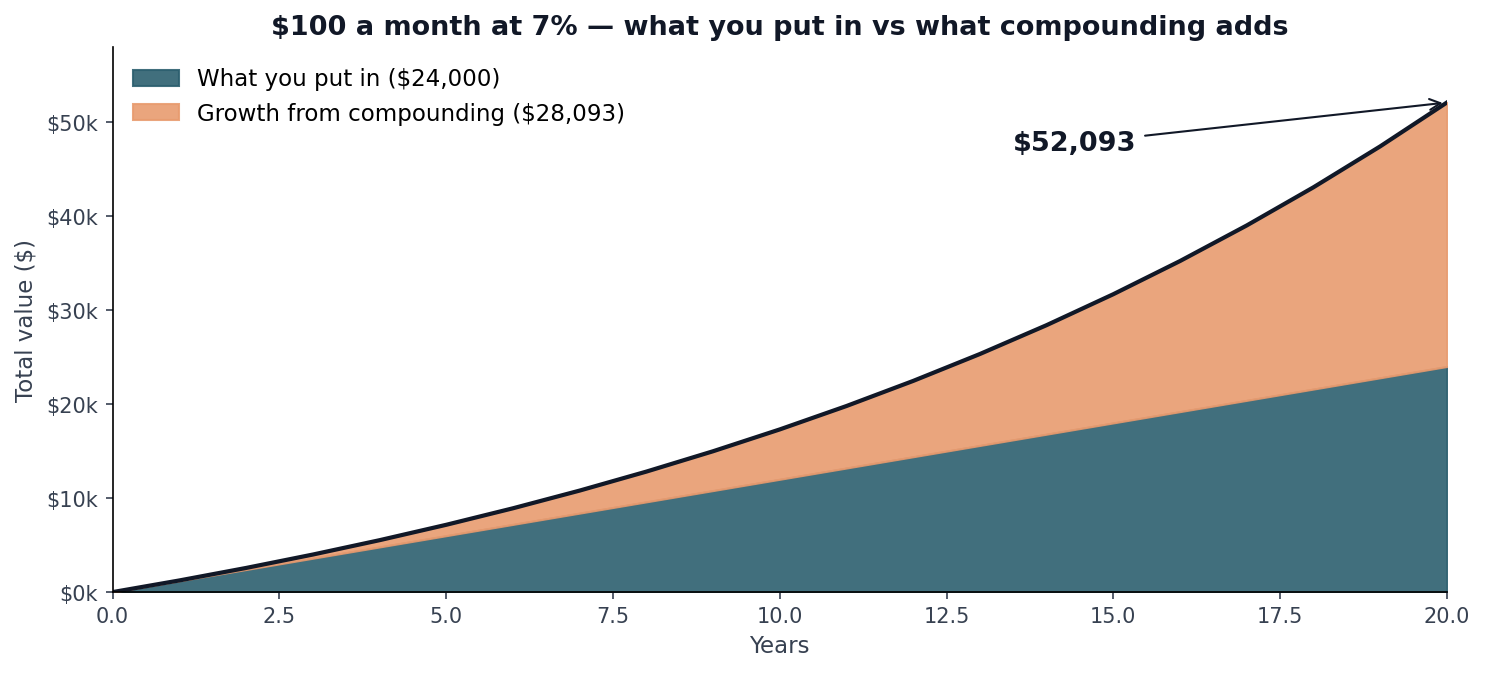
Read that second column twice. After 20 years, you put in $24,000 — and compounding added $28,093 on top. More than half of the final balance is money you never deposited. Your contributions stop being the biggest part of the total; the growth does the heavy lifting.
Why the second decade does the work
In the first few years, almost nothing seems to happen. After 2 years you have $2,568 — just $168 more than the $2,400 you put in. After 5 years the growth is still a small slice of the total.
Then the curve bends. The money your money earned starts earning money of its own, and the growth column starts growing faster than the contributions column. By year 19, the growth ($24,625) has overtaken everything you ever deposited ($22,800). From then on, compounding is contributing more than you are.
That is the whole secret of compound interest: it is slow, then it isn't. The first decade builds the base. The second decade harvests it.
What changes the outcome
Three things matter, in this order:
- Time. Starting 10 years earlier beats saving twice as much later. The 10-year total ($17,308) is barely a third of the 20-year total ($52,093) — the second decade adds $34,785, nearly three times what the first decade produced.
- Consistency. The habit matters more than the amount. $100 every month beats $1,200 once a year at random, because every month your money starts compounding sooner.
- The return. 7% is an assumption, not a promise — it is roughly the long-run average often used for illustration, but real returns vary year to year, and some years are negative. A lower return shrinks the growth column fast, which is why the habit matters more than chasing the highest rate.
Try it with your own numbers
- Pick a monthly amount you can actually sustain — $50, $100, $250, whatever fits.
- Enter it in the compound interest calculator with a 7% return and 20 years.
- Compare the "total invested" and "interest earned" lines. That gap is the whole story.
- Then change the time to 10 years and to 30 years, and watch how much the ending changes. Time is the lever.
Or ask the AI assistant in plain English — "What happens if I save $100 a month for 20 years?" — and it will walk you through the same scenario and explain what the numbers mean for you.
This is general education, not financial advice. The 7% return is an illustration, not a guarantee — real investments go up and down, and your actual results will differ. Consider speaking with a licensed financial professional before making investment decisions.
More guides
- Black Friday Math: Is That '40% Off' Deal Actually a Deal? — November 28, 2026
- When Is My Baby Due? How Due Dates Actually Work — November 18, 2026
- What Pace Do You Need for Your Goal Race? — November 18, 2026